
ANIMAL

ORTHOPAEDIC

CLINIC

OF FLORIDA

Tibial Plateau Leveling Osteotomy

Home / Our Services / Tibial Plateau Leveling Osteotomy
The tibial plateau leveling osteotomy (TPLO) is the most commonly performed orthopedic surgery in dogs.

What it is for?

TPLO is a surgical procedure for cranial cruciate ligament (CCL) tears in dogs, and occasionally cats. The CCL is located inside the knee (stifle), and its main role is to prevent the shin bone (tibia) from sliding forward relative to the thigh bone (femur). In dogs, it plays an even more important role than the ACL does in people — without it, the joint will always become misaligned during weight-bearing.

Unlike people, dogs usually don’t tear their CCL from a single injury. Instead, the ligament gradually degenerates over time. We’re still not sure why it happens — it may be due to how the joint is loaded (biomechanics) or something within the ligament itself (biology).

Once the ligament tears, the joint becomes unstable, leading to inflammation, pain, and eventually arthritis. Often, the CCL is frayed and still providing partial stability, but the joint is irritated. Regardless, CCL disease typically causes ongoing lameness if not treated. CCL disease can affect dogs of all sizes, ages, and activity levels.

How Does it Work?

Think of the stifle joint as having two slippery surfaces. The femur surfaces are very round, while the tibial surfaces have a downward slope. The job of the CCL is to keep the femur aligned in the middle of the slope. Once the CCL ruptures, the joint becomes unstable as the femur “slides” down the slope of the tibia during weight-bearing.

The goal of TPLO is to flatten, or level, the slope, so the femur does not slide downward. In other words, TPLO alters the shape of the joint such that the joint no longer requires the CCL.
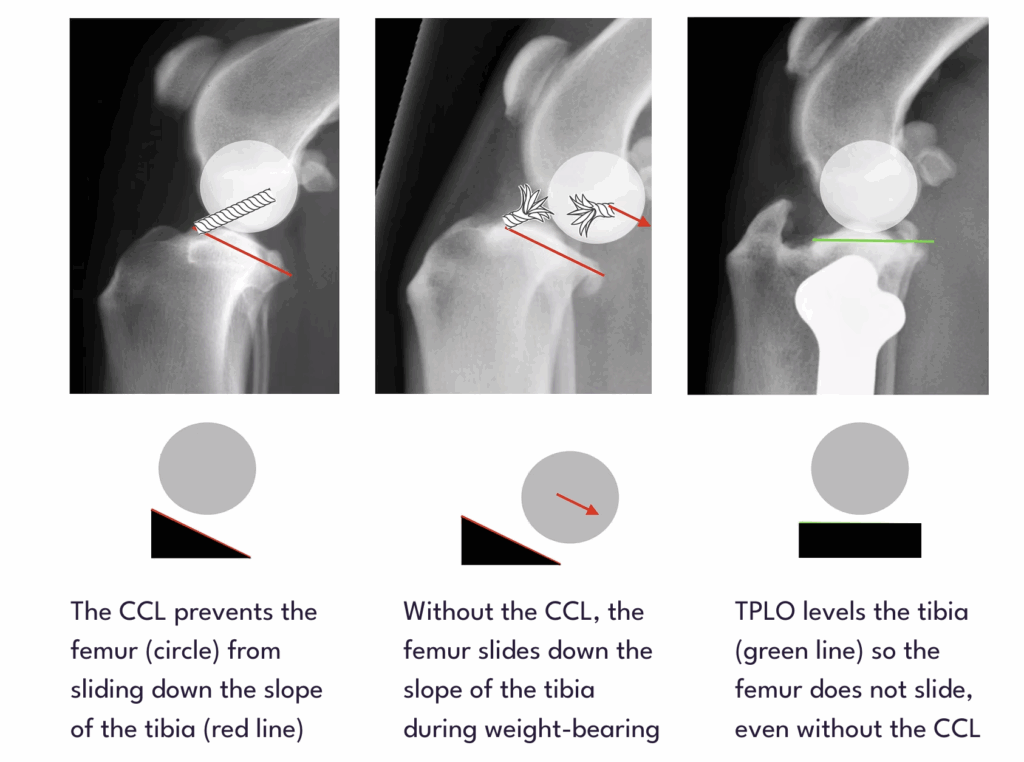
Diagram showing how TPLO surgery changes the tibial plateau angle.
Diagram showing how TPLO works.

What is the surgery like?

There are two main parts to the surgery. First, the inside of the joint is inspected, either by opening it up (arthrotomy) or through minimally invasive “keyhole” surgery with a small arthroscope. Arthroscopy provides better visualization and is less traumatic, but requires specialized equipment and an experienced surgeon. The CCL rupture is confirmed, and any meniscal injury is treated by trimming the damaged portion.

Then, the bone is cut with a special saw, and the tibial plateau segment is rotated into the desired position. The cut in the bone is stabilized with a bone plate and screws.

Are all TPLOs performed in the same way?

Every TPLO has the same goal — stabilizing the knee — but the exact procedure is tailored to each dog. Factors such as the amount of instability, the presence of other issues like limb deformities or patellar luxation, and the size of the patient all influence the details of the surgery. Implant selection, quality of equipment, and method of joint examination also vary.
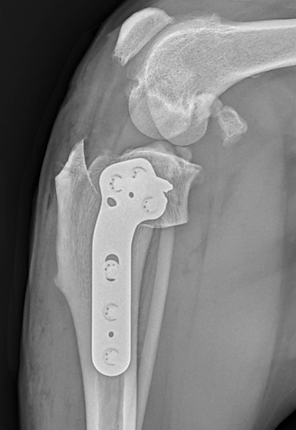
TPLO leveling illustration and post-operative radiograph.
TPLO leveling illustration and post-op radiograph.

How long is the recovery?

Most dogs begin using the leg within a few days, but full recovery takes several months. Strict activity restriction is critical in the first four weeks after surgery, and consistent use of the limb with some limping is expected. By 4–6 weeks, most pets are walking on a leash comfortably, and bone healing is well underway. Full return to normal activity — including running and playing — usually happens after about three months, depending on your dog’s age, size, and activity level, as well as whether any additional procedures were performed.

What can go wrong?

As with any surgery, TPLO carries risks. Most dogs experience only mild, transient effects such as swelling or bruising. More serious problems — such as infection, implant loosening, meniscal injury, or delayed bone healing — occur less often, and they are usually treatable. Certain dogs, like giant breeds and English Bulldogs, are at higher risk of major complications.

Prognosis

Studies have shown that over 90% of owners are very satisfied with the outcomes of TPLO. Our expectation is that dogs should be able to return to, or close to, pre-injury levels of activity. Even some working or agility dogs can return to peak performance. However, dogs with pre-existing severe abnormalities such as advanced arthritis or concurrent deformities may not achieve a fully desirable result.

How do I pick the right surgeon?

TPLO is a very common surgery and offered by many veterinarians, but the surgeons’ training and experience can vary widely. Some are general practitioners, others have residency training or board certification, and a small number are recognized leaders in the field through high case-loads, research, and teaching.

When deciding where to go, it’s reasonable to ask:

  • What are your qualifications?
  • How many TPLOs have you performed?
  • What is your complication rate?
  • How do you evaluate and treat the meniscus?
  • What other treatment options are available, including referral?
  • What is the estimated cost and what does it include?

These questions can help you find the right match for your pet’s ne

Why AOCF?

At Animal Orthopaedic Clinic of Florida, every patient benefits from unmatched expertise. Our head clinician is an internationally recognized leader and researcher in veterinary orthopaedic surgery. Using evidence-based, individualized care, we are dedicated to giving your dog the best chance at long-term, pain-free mobility.

  • Pozzi A, Natsios P, Kim SE, Choate CJ, Conrad BP. Relationship between the shape of the tibial plateau and femorotibial contact mechanics after meniscectomy in the canine stifle. Front Vet Sci 2025, 12: DOI link.
  • Peterson LC, Kim SE*, Biedrzycki AH. Evaluation of a crescent saw guide for tibial plateau leveling osteotomy: an ex-vivo study. Vet Surg 2022, 51:509-519.
  • Jeong JM, Jeong SM, Kim SE, Lewis DD, Lee HB. Subsequent meniscal tears following tibial tuberosity advancement and tibial plateau leveling osteotomy in dogs with cranial cruciate ligament deficiency: an in vivo experimental study. Vet Surg 2021 50:966-974.
  • Tinga S, Kim SE*, Banks SA, Jones SC, Park BH, Chapman SM, Pozzi A, Lewis DD. Femorotibial joint kinematics in nine dogs treated with lateral suture stabilization for complete cranial cruciate ligament rupture. J Am Vet Med Assoc 2021 258:493-501.
  • Zann GJ, Kim SE*, Tinga S, Pozzi A, Banks SA. The effect of tibial plateau leveling osteotomy on patellofemoral kinematics in dogs: An in vivo study. Vet Surg. 2020 49:207-213.
  • Tinga S, Kim SE*, Banks SA, Jones SC, Park BH, Burch M, Pozzi A, Lewis DD. Femorotibial kinematics in dogs treated with tibial plateau leveling osteotomy for cranial cruciate ligament insufficiency: An in vivo fluoroscopic analysis during walking. Vet Surg 2020 49:187-199.
  • Nazarali A, Singh A, Moens NM, Gatineau M, Sereda C, Fowler D, Kim SE, Kisiel A, Reynolds D, Ringwood BR, Bruce CW, Gibson TW, Rousseau J, Weese JS. Association between methicillin-resistant Staphylococcus pseudintermedius carriage and the development of surgical site infections following tibial plateau leveling osteotomy in dogs. J Am Vet Med Assoc 2016 247:909-916.
  • Kim SE*, Jones SC, Lewis DD, Banks SA, Conrad BP, Tremolada G, Abbasi AZ, Coggeshall JD, Pozzi A. In-vivo three-dimensional knee kinematics during daily activities in dogs. J Orthop Res 2015 33(11):1603-1610.
  • Jones SC, Kim SE*, Banks SA, Conrad BP, Tremolada G, Abbasi AZ, Lewis DD, Pozzi A. Accuracy of Measuring Three-Dimensional Femorotibial Joint Poses in Tibial Plateau Leveling Osteotomy Treated Dogs Using Non-Invasive, Fluoroscopic Kinematic Analysis. Am J Vet Res 2014 75:486-493.
  • Pozzi A, Dunbar NJ, Kim SE. Effect of tibial plateau leveling osteotomy on patellofemoral alignment: A study using canine cadavers. Vet J 2013 198:98-102.
  • Skinner OT, Kim SE, Lewis DD, Pozzi A. In vivo femorotibial subluxation during weight-bearing and clinical outcomes after tibial tuberosity advancement for cranial cruciate ligament insufficiency in dogs. Vet J 2013 196:86-91.
  • Kim SE*, Lewis DD, Pozzi A. Effect of tibial plateau leveling osteotomy on femorotibial subluxation: in vivo analysis during standing. Vet Surg 2012 41(4):465-470.
  • Kim SE*, Lewis DD, Pozzi A, Seibert RL, Winter MD. Radiographic quantitative assessment of cranial tibial subluxation before and after tibial plateau leveling osteotomy. Am J Vet Res 2011 72(3):410-416.
  • Kim SE*, Pozzi A, Banks SA, Conrad BP, Lewis DD. Effect of tibial tuberosity advancement on femorotibial contact mechanics and stifle kinematics. Vet Surg 2009 38(1):33-39.
  • Kim SE*, Pozzi A, Banks SA, Conrad BP, Lewis DD. Effect of tibial plateau leveling osteotomy on femorotibial contact mechanics and stifle kinematics. Vet Surg 2009 38(1):23-32.
  • Kim SE*, Pozzi A, Kowaleski MP, Lewis DD. Tibial osteotomies for the treatment of cranial cruciate ligament insufficiency in dogs. Vet Surg 2008 37(2):111-125.